There’s a Truxton Circle article I’m sitting on that I need to rewrite.
I’m also a church archivist for a church I don’t belong to. There’s some work that I’ve been putting off. I said I would get to it in Spring. Spring is over, and haven’t done anything. But I have done some preliminary oral history work. This is time consuming and has taken my attention away from this blog.
And I’m not particularly interested anymore in doing property histories. What makes me happy is researching people. The DC Recorder of Deeds is very helpful with looking up people, but I don’t want it to be my main thing. Since I need to clean up my census data, I’m going to see if I can mix blog writing with data clean up.
And there are personal things or life in general. I suspect getting older makes it harder to do as much as I used to. sigh.
Not really sure what to do with this. I was actually looking for other documents and discovered this in a odd folder.
Official Postal Guide July 1939 coverFrom Official Postal Guide, 1939
Why did I collect this info? dunno. Where did it come from? Probably the National Archives, whatever the RG is for postal records. So if that is the right cover, the term Truxton Circle associated with a place goes back a while. Not sure what the importance of a postal station is.
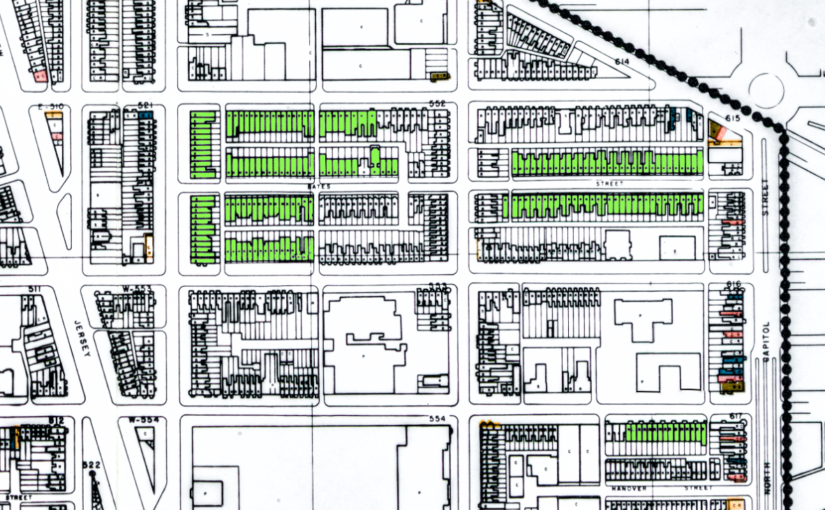
This post serves no purpose other than to have a list of who owned what lots on Square 507. If you are interested in who lived there, check out the Square 507 (bounded by NJ, RI, FL, 4th and R Sts NW, with Richardson Place in the middle) page at TruxtonCircle.org.
This is from the National Archives Catalog for RG 351 entry P1, General Assessment Washington City, 1933-1934, File NAID 143492761.
If you want to match “most” of the lots with whats above, go to DC Property Quest.
Dr. E.L. Haynes (see her Wikipedia page here) owned several properties in and outside of Truxton Circle. Her tenant Mrs. Emma Brown at 1513 4th St NW was irregular in her rent payments.
I’ve been doing this neighborhood history thing for well over a decade and I have learned some lessons. Doing these mini genealogies and digging into the land records, newspaper clippings and other research I discover the people who lived here were complicated people. Just as complicated as you or I.
Recently, I’ve seen a couple people bring up the Equal Credit Opportunity Act of 1974, claiming women could not own land, have a credit card or bank account in their name, etc, before 1974. Really? But several things can be true at the same time. There are women now who are unbanked/ debanked. My sister-in-law was unbanked until she was able to get POA over my mother-in-law’s nest egg & bank account which she drained before abandoning the old woman.*
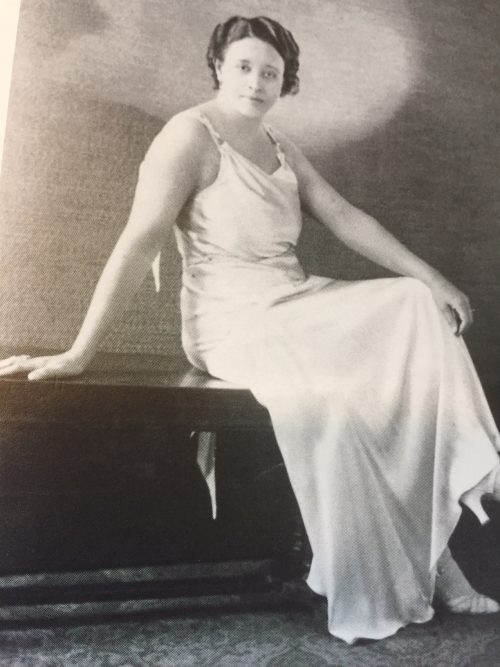
Eloyce Gist
Anyway, Truxton Circle has many female homeowners and landladies who owned property in their own name with nary a man in sight. Eloyce Gist, never had any of her husbands’ names on the documents. The only man who ever had his name on 134 R St NW was her father when it was purchased with her parent’s help in the 1920s. Dr. Euphemia Haynes-Lofton, owned lots of property in DC in her own name. Then there was Kat Miller who owned several properties as well. Followed by all the divorcees, widows and single women who purchased WSIC houses in the 1950s. Speaking of WSIC homes, I am reminded of pre-WSIC owners Marie Clarice Eustis and Louise Eustis Hitchcock.
Dr. Carrie H. Thomas, who seemed to have inherited 1629 NJ Ave NW from her father, never married. Sometime before 1910 her father had died and she died in 1930, which meant she owned the house free and clear for at least 20 years. She had a career and a life.
Louise Marie Eustis. Source -Wikimedia
It seems to reason that if women were owning property, acting as landladies or real estate investors or plain old homeowners they would have bank accounts. I’ve seen enough mortgages where women held the debt in their own name, sometimes even when they were still married. All well before 1974.
Believe it or not, a woman in say 1920 be unmarried and financially independent. She could be like Mary Harvey Chiswell who was instrumental in changing the 1700 block of New Jersey Avenue in 1920.
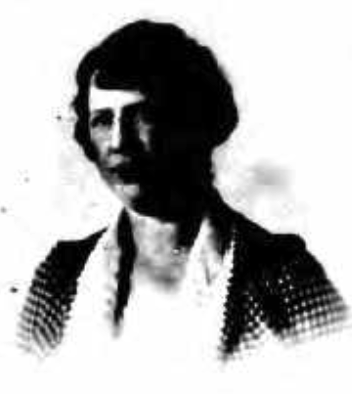
M. Harvey Chiswell, 1924 Passport Photo
She did not marry until she was well into her early fifties. In the 1941 article announcing her nuptials to Maj. Joseph Byers II, she was described as a “prominent Washington career woman”. What she did on New Jersey Ave NW wasn’t her only real estate investment, she was all over the DMV.
I really do need to do a thing on Dr. Haynes-Lofton as I have seen her bank account info.
These women did not need the Equal Credit Opportunity Act of 1974. They managed to get along quite fine without it. They owned property. Some had careers. Many were getting on with the business of living (and eventually dying).
*Why yes. My MIL has been dead for 8 years, and we are still hurt and bitter. We forgave but did not forget, and we moved on. Like one does from any major injury.
One of my favorite National Archives resources for Shaw historical information was RG 328, Records of the National Capital Planning Commission. I found photos, maps, and loads of information about the transformation of the neighborhood, before and after the 68 riots, in this record group. But in looking back at some of my old posts, I’d discover that a former NCPC executive director, Reginald W. Griffith, had written about Shaw as an urban renewal area.
There was an oral history of Black alumni of M.I.T. and Griffith described how he came to DC. He was working for the Boston Redevelopment when the opportunity to work with MICCO—the Model Inner City Community Organization in Washington, DC came up. He moved his family from Boston to DC to be a community activist. From his point of view he was pro urban renewal, an hoped to renew Shaw. In his thesis, he acknowledged the community’s outlook that ‘urban renewal is negro removal’.
He thought the Shaw neighborhood was the hardest hit by the 1968 civil disturbance/ riot. But there was a lot of opportunity afterwards. “The local planning agencies basically abdicated their functions. They didn’t know what to do. So we at MICCO, who were initially finding out from the community what they wanted and finding out what the planning agencies were doing and telling the planning agencies what the community would like, found ourselves in a unique position. The local planning agencies basically backed off, threw up their hands, and said, “What do we do?” The community was saying, “We’ve got to do something.” MICCO filled the vacuum.
As a result, we accomplished a lot. We were able to get black architects their first new schools, but it wasn’t easy. In fact, the politics of the situation was such that when we were about to do that, these same architects were offered bigger school additions as a diversionary ploy, because the rules of the game were that if you were doing one school, you couldn’t do another. MICCO knew there would be a new Shaw Junior High School, we knew there would be a new Dunbar High School. These were multi-million dollar jobs that were in the heart of the black community and could be given to qualified black architects, and there were lots of qualified black architectural and engineering firms around. ”
According to the National Capital Planning Commission’s May 4, 2017 meeting transcript, Griffith served as NCPC’s Executive Director from 1979 to 1999. The mentioned him because he had died. I can’t seem to find an obit, so I will go with what the NCPC said.