Recently in Gentrification Category

History of Redlining, is it still applicable?

| No Comments

Thinking back at the traveling book group, and something the Director of the Office of Planning had said is slightly bugging me. She mentioned redlining. Redlining was when banks and insurance agencies refuse to service or provide loans to certain communities (typically African American). The 1968 Fair Housing and 1977 Community Reinvestment Acts combatted redlining. But later there was reverse redlining which brings subprime mortgages, which is more applicable, I think to our situation than the original redlining.

The other problem, if we are just talking mortgages and redlining (not an expanded definition that goes into retail), is that a lot of properties in my neighborhood, were rentals. The residents were mainly renters, which means, they weren't looking to buy. There were homeowners, and I can think of a couple households made up of really old timers (pre-1980s, pre- 1st wave of Shaw gentrification) who own, or at least grandma owns. But those homeowners are outnumbered by the renters. My house has a strong history of being a rental for most of the 130+ years it's been standing. These things have been bought and sold by investors who are not too dependent on the whims of some random loan officer. Buying a place with cash makes the process go by sooooo much faster.

But I digress.

My block, I believe, are made of mostly owners. When I bought it 10 years ago wasn't like that. There were (what I thought were) Section 8s, a few low priced rentals, and a bunch of vacant townhomes. The block was not suffering from redlining. It suffered, for a brief time, from the loans given out to every Tom, Dick and Harry who was breathing, regardless of if they were already leveraged to the hilt, couldn't afford to maintain the home, or couldn't pay the mortgage when the rate eventually adjusted up.

Yesterday in the Washington Post there was an article about long lines to get on the waiting list for a federally subsidized apartment complex in Columbia Heights. Though one could really sympathize with the folks in the line, the article left me with questions.

The article is short so that may have had something to do with the lack of saying how much these places were going for. Yes, they are low cost rentals but what exactly is a low cost rental in Columbia Heights in 2011-2012? Is it $400? $500? $800 for a 2bedroom? Is it a sliding scale based on income, and if so what is that? Comparatively what does the average 2 bedroom apartment (non-basement) go for in Columbia Heights. Also are there any like complexes in other parts of the District that have the computer room and an after school program? Do they generate such turn out?

Yes, Columbia Heights is gentrified, but why does that attract a low income population? Okay, that question may take an academic level of inquiry. If this complex was in Deanwood or Avondale or Ft. Lincoln would there have been a long line up? If it were in those places would the WP readership care? 

Jerry Weinberger of the City Journal, a libertarian occasionally conservative journal on urban affairs, claims in his article "Gentrifying Washington, DC" it does. So he uses an incident on his street in Capital Hill to illustrate his point.

Friendlier? Eh, I don't know. The drug dealers on the corner were friendly. There is a new crew of old guys selling, old as in their 40s looking 50, which makes me appreciate good living and exercise. They pretty much ignore anyone that doesn't look like they're buying and may grumble a greeting if you pass close by, maybe. Cindy (the ex-crackho) is still as friendly as when she was selling herself cheap. The block I used to avoid, has a friendlier vibe. That one is hard to gauge.

More diverse? Yes. First let's define diverse. More than just one type of demographic. Shaw and more specifically the TC had been overwhelmingly African American for at least 70 years. My TC study showed that the area that from 1880-1920 had been diverse wham! became black and kinda stayed that way until the 2nd wave (I think the 1st was in the 80s) of gentrification. And it is that change to have more economic and racial diversity the cries of gentrification get thrown around.

Art and Gentrification

| No Comments

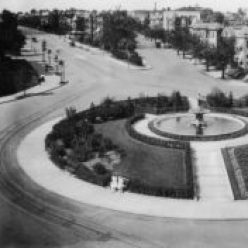
IT-Logan Cir Art.jpgIT had an exhibit opening over on 14th Street at the HAL gallery in Logan Circle on Friday.

Anyway IT tends to do installations. I love IT and I want to be supportive, but most of the time, I just don't get it. Which was why another neighbor and artist who gave his interpretation was soooooo helpful. To quickly sum up what I saw, the installation was in a small dark bedroom, with a twin sized cot wrapped in a sleeping bag and heavy chains off to the sides. Behind the bed were transparent images of maniquin heads looking away. On the floor there were tiles of cardboard and a tree stump. The tree stump was connected with chain to the bed with chains. There were also photographs of the Logan Circle area circa 1990-something.

So what I can give is a small interpretation of Bri's interpretation of IT's work. If you want Bri's interpretion, you're going to have to ask Bri. I'm interpreting the interpretation. Elements are about gentrification. The cot and sleeping bag represent people who have moved into the neighborhood, who are just camping out in Shaw, until they move on to the next rung in their career ladder. They are not permanent. They are also represented by the dummy heads who do not interact with the viewer. The dummies stand in for the people too ingrossed in their crackberries and smartphones to engage with other people in the neighborhood. The stylishly cardboard tiled floor represents the homeless, another sort of transient. The tree stump represented something else, can't remember now.

Ah I should have written this all out when it was fresh.

Jobs

| 1 Comment

I've been thinking about a comment this blog got from about gentrification:

I think we can resolve the apparent contradiction ("damned if it gentrifies; damned if it doesn't") by looking at the post 70's history of DC, and black economic mobility. For about three decades, the focus was on "jobs creation". This took the form of DC government creating as many government make-work jobs as it could (at the cost of fiscal collapse), and putting poor residents into those jobs. This lifted tens of thousands of DC residents--and their families--out of poverty and into the middle-class. They largely moved to the suburbs once they had the means.

Suburbs, probably PG Co., also known as Ward 9.

With gentrification, you've seen a switch in focus away from maximizing public employment to optimizing government services. (Number of public employees went from 30k to 12k between its height during the Barry years and nadir under Fenty)........

Efficiency, probably made the jobs that the city might tried to create to lift some of its citizens out of poverty, unneeded and unwanted. Considering government budgets and bond problems, I don't see a change in the trend. The trend is to do more with fewer people, not just in government, but in business, everywhere.

When I look at period dramas like Mad Men, Life on Mars (British) and Downton Abbey, I see jobs that will be swept away by techology and trends. The chambermaid who wakes up early to light the fires in the great house will be replaced by a good HVAC system with timers and automatic temperature settings. The Afro-American elevator operator will be unneeded as people discover they can press their own buttons. The textile factory workers will all be let go as consumers favor cheaper fabrics from overseas. And personally I wish offices and agencies still had a Joan, keeping the paperwork and the office in order. Oh, and have you noticed the complete lack of a secretarial pool in your office?

In the book Shopcraft as Soulcraft, author Matthew Crawford, makes note of how jobs have been dumbed down, starting with blue collar work and slowly creeping into white collar professions. As the jobs start making specialized knowledge and skills unnecessary, it makes the number of skilled workers, expensive workers unnecessary. So if you need fewer college educated workers, you might not need an army of minimally educated DC citizens either.

So the government, and efficient government, isn't going to hire an army of lower income DC citizens, provide them with jobs, employer sponsored health care and a sense of worth. It's just easier to maintain a paternal system of handouts. Besides if you provided jobs they'd just wind up moving out of the city anyway, which does nothing to hold back gentrification.

I was asked to take a look at the American Observer's article touching on gentrification "Rising Values for D.C. housing, but who can afford it?" It doesn't do the usual race baiting, and sticks to numbers, but it does talk about racial differences. Yet reading it, it seems to not address (for me at least) the damned if it does, damned if it doesn't situation. It being, development, growth, and a rise in property values.

The article covers the usual ground of NW DC is experiencing this growth and investment and in PG County, also known as Ward 9, there is the highest foreclosure rate in the area. So shortcut, white areas are getting the investment, black areas the disinvestment and failed investments. But when investment comes to areas that need it, it apparently is a horrible thing because that pushes out poor people, which means poor black people and some Latinos. If investment stays away, that means poorer areas don't get the benefit, but if it comes in, it means displacement. Damned, no matter what happens.

Solutions presented in the story are something called value capture, which I think means setting aside units and extra taxes or fees, and helping tenants buy their apartment buildings. Several developments do already have set asides, or at least start out talking about having a few units for low income households. The tax/fee thing, I don't like. This is DC, that money will find its way to a Lincoln Navigator or buying fur coats for family members or to crappy non-profits no one has ever heard of that don't do anything. The apartment building buyout works more when you've got a building over 2 stories with more than a handful of units. In Shaw, single townhomes outnumber the apartment buildings. So for every Immaculate Conception/1330 you have a hundred small time landlords with a house here or a house there.

There is also a interview of Derek Hyra included. It will be interesting to read his book when it comes out as it is about Shaw and urban renewal. In the interview (Youtube) at the 3:30 mark, I have to disagree with him about the influence of the Reeves Center. The Reeves Center was at best a neutral factor. Seriously, when was the last time you headed inside there for anything? Outside, for the farmer's market, yes. Inside? Maybe once. The finished metro, which I've been in the U St Station a million times, and the various eateries and bars should get more credit.

Oh, Renew Shaw has a post stating there has been a buyer for the Kelsey Gardens (was to be Addision Square). Yes, low income people used to live in Kelsey Gardens. But the church that owned it wanted it developed, and they emptied the buildings and then, nothing. And more nothing. And now a little something, but until I see my favorite sight of guys in hard hats doing stuff, it ain't nothing.

Marion Barry fightin' gentrification, in his own way

| No Comments

Oh take a read at the Housing Complex's post "Marion Barry Calls for Gentrification Commission." It's all about Ward 8, and Barry heading off a wave of gentrification that will, I dunno, get him out of a job? Seriously, if you live in a gentrifed or gentrifying hood would you vote for Barry?

Barry is 75 year old. He needs to retire. Let some new blood in. But y'all in Ward 8, you do whatcha need to do.

Black Gentrification

| No Comments

I read a book some time ago on the topic, Harlem: Between Heaven and Hell, by Monique M. Taylor, about the influx of a black middle class into impoverished Harlem showing how the issue of race, when the two parties are of the same minority, and class. The New York Times has a pretty good article from 2008 "Harlem Pas de Deux", which shows more of the class issues and hostility of lower income blacks towards higher income blacks.

The Washington Post in today's dead tree edition (it was up earlier in electronic form), covers black gentrification in Anacostia and Ward 8 in "Black Middle Class is Redefining Anacostia". I know it was up earlier because Richard Layman had typed out his thoughts 2 days ago about it.

I don't have too much to add, except to say neighborhoods change. I'm still plugging away at the 1880-1930 census project and trying to map out people on the Sanborn Fire Insurance maps. Streets, okay alleys, come and go. Places that were there one year are gone 10 years later to make way for a school, or new housing, or businesses. When I'm done with one aspect of the project I want to take it to the city directories and look at one street that went from being completely white to completely black in 10 years. I want to see where the people who left went and where did the people who replaced them came from. The only problem is that they are mostly renters, and renters are known for up and leaving after a few years. 'Tis the joy of renting.

Progress of Gentrification

| 3 Comments

The Editor of the BaancBlog mentioned something interesting:

The gentrification of Logan Circle began in the 70's and the gentrification of the Blagden Alley and Naylor Court environs began in earnest in the early 80's. That doesn't mean population increase, but the renovation of (often abandoned) housing. With the accompanying decline in drug dealing and murder in the territory, it became safe to build the available zoning envelope. That is, a lot of condos and multi-unit rentals. That's the population spike relative to the rest of DC. That's mostly over.

Back when I was researching buying a house, 10 years ago, I looked at how gentrification moved. I can't remember if it was "Upscaling Downtown: Stalled Gentrification in Washington DC" by Brett Williams or another book (I read a lot) that noted the flows of gentrification and what stalled it. From where I was sitting at the time the flow was going from Dupont, into Logan, and heading east, but how far east, who knew.

Also I realized as, the Editor has pointed out, gentrification can be slow. Logan's gentrification began in the 70s, say late 70s and it's now 30 years past. 30 years, that's older than some of you reading this. 10 years ago when I moved out of my 12th and Rhode Island Ave apartment near Logan Circle, there were only homeless guys hanging out in the circle. That's changed. There is stuff that hasn't changed. That red wood blighted eye-sore on the 1400 blk of 11th was a blighted eye-sore 11 years ago. It survived gentrification, the real estate boom, and unless the city or the owners do something, it may still be a red wood eye-sore in the next 10 years. There are other vacant and abandoned houses just off 9th, which also managed not to get touched during the great housing boom. However, around these eye-sores are some pretty nice houses and businesses that slowly, over the past 30-20-10-5 years have come up. But lower on 9th, near Blagden Alley and Naylor Court the cool businesses are surrounded by vacant store fronts and bordered by a fortress known as the Convention Center. Housing is nice around there though.

The gentrification that is occuring east of 9th is slow. Near the Convention Center I'd say it is about 20, getting to 30 years old. Over here in the TC? I don't know. There was a slow change in the past 10 years. Turnover has favored those who want to be homeowners, and when those homeowners decide to become landlords they tend to rent to people of the same class. There are still plenty of people in the TC who were here over 10-20+ years ago, homeowners, folks in the co-op, and renters with landlords who haven't bothered selling or improving the place enough to justify a price hike. The old-timers.

In the next 10-20 years who knows what will happen in the TC as there is much more room for improvement and change. Maybe something will happen with Slater, Langston, and Cook. Who knows what impact the change with MM Washington into Senior housing will have in the area around S.O.M.E. Maybe commerical pressure from NoMa will leap on to North Cap and it becomes attractive to business, or not. Maybe Joe Mamo will do something with his lot on the corner of FL and N. Cap that the neighborhood approves of, spurring development near by. Maybe something will get built at NJ and P. Maybe, something will happen with various vacant and underused properties in the TC, changing the place for the better.

TC offends Reston Man

| No Comments
I've had very little contact or experience with the area known as Reston. My last trip there, we got lost, had issues with tolls, and a problem when when we desperately  needed some saline Sunday at 9pm and found the main commercial corridors shut down.  So my experience with Reston is of a spread out, pedestrian unfriendly place that shuts down at 9. I could be wrong. I really don't spend a lot of time on the other side of the Potomac, particularly places beyond metro rail, so what do I know.
This is about the response to the article about the TC (Truxton Circle) in the Where We Live area of the Real estate section. Which from some of the residents seemed positive enough, acknowledging the crime (yes w/ 2 shootings in one week, hard to ignore), but also acknowledging progress.
In the Free For All this morning Mr. Glenn Kamber, a citizen of Reston and a member of the Fairfax-Fall Church Community Services Board, wrote that he found the article disconcerting. He railed against NIMBYism (for us it is NMIMBY- No MORE in my back yard) and the usual gentrification cries of displacement of black people, shorthand for poor black people. And I don't know what he's talking about regarding displaced Latinos in the TC, this isn't Ward 1, African Americans are still the dominant ethnic group in the TC, but you know all those DC urban areas look alike.
In regards to social services, let me illustrate something that you might not get out in Fairfax County. If I step outside onto my top stair landing I can see two places that serve the homeless. One is a church whose aid is most visible on one day, another is run by a suburban Virginia church that serves during the week, sometimes on the weekend. If I step further out about 6 feet from my front door and squint (I need new glasses) I can see another place that I highly suspect is a social service. If I walk about 250 feet from my front door there are a few other properties that are used for temporary housing and services. And I'm in the least problematic area of the TC. Also in the past year we were informed by a study that our commercial strip is pretty much doomed to be a wasteland because of the concentration of social services, which is why the cool stuff like BBC and Beau Thai (and maybe the firehouse) is near the TC but not in the TC.
Okay let's talk race, more accurately ethnicity but according to DC rules, 'race'. In the last census most of the TC was 62% Black, yes this is down from 92% from 2000, but way more diverse than parts of NoVa. Playing with the Post's Census Date Map  I see when I flick around Tyson's Corner the 80some percent of whites went down to 70 and 50 something percent apparently displaced by Asians. The percentage of Latinos in the TC hasn't been high, in the west part of the TC it jumped from 2.8% in 2000 to 6.8% in 2010, eastern sticking around the 8 something percent. And the Latino convert a school into primarily housing project is too complicated with a whole historic narrative to go into here. Just know that adjacent to that project at MM Washington, the plans for low-mid income housing for seniors is chugging along. If the example of Golden Rule Plaza is what we can expect, then that portion of the neighborhood will remain African American as GR seems to lack diversity.